
July 31, 2020
This is a little off the topic, but stays in the realm of Flutes and can be educational.
Today I saw an offering on eBay for a 1998 Haynes Flute that appeared to have a professional, handcrafted design. Something was odd about it. Upon closer inspection I noticed that it does not have French pointed key arms. Instead it has Y arms like a commercial model. But it looks strangely French. I realized it employed a design that Louis Léon Joseph Lebret (b. 1862) used – “raised nipple” style key cups. I’ve only seen a few other historical flute makers make use of this key cup design. I wondered if 1) Haynes was trying to promote / experiment with reviving the design, 2) custom designed by request or 3) give the instrument expensive look while keeping the cost at commercial model level. I must say it does give the instrument a uniquely elegant touch.
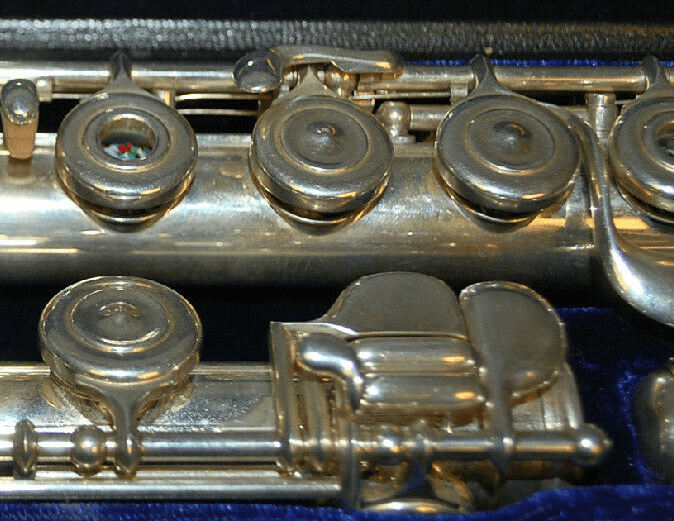
From what I can tell from the available pictures, the tone holes appear to be machine rolled and not soldered, which points to a commercial model. I may be wrong.
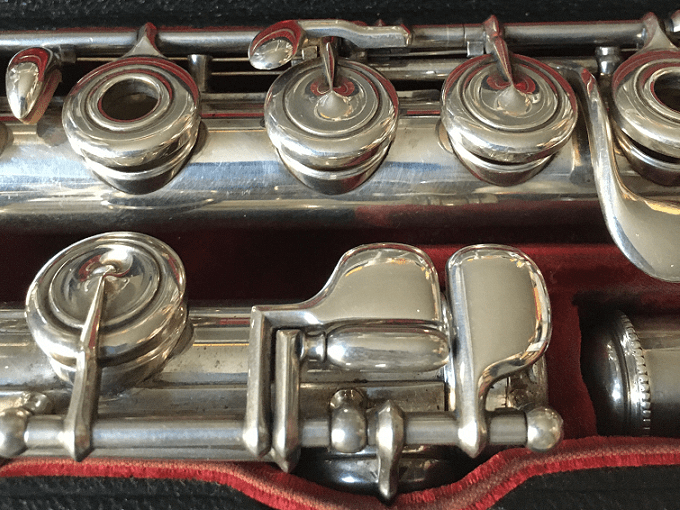
Just for comparison purpose, below 1939 Haynes has the tell-tale signs of handmade instrument – French pointed arms, as well as soldered tone holes. For those not too familiar with flutes, the foot joint on the above instrument has three parallel keys (all together four keys) for the right hand pinky to work while the picture below has only two parallel (total three keys). The flute above has a B-foot while the one below is C-foot.
Below is a L. L. Lebret’s flute to further compare the design. This is the real thing. It is one of my project flutes that I haven’t had any time working on because of other priorities. It will require a lot of work to bring it back to life, including removing rusted steels in addition to taking years of grime and tarnish, hopefully without damaging much the plating underneath.
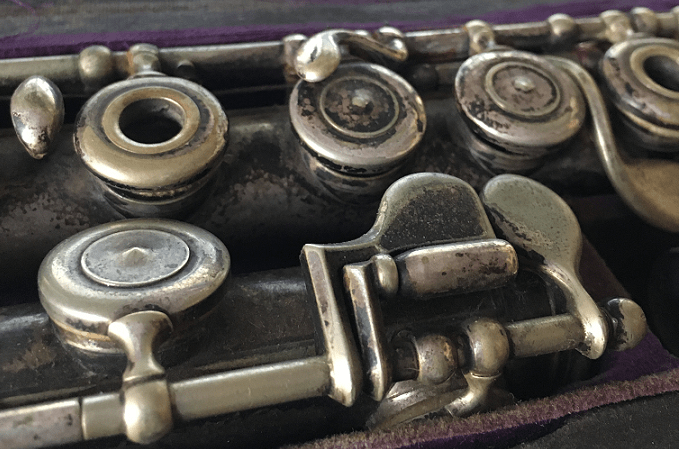
You can see what I mean about the “raised nipple” style design. The tone hole is soldered and the arm is not a Y but an elegant “longish ball and pillar key arm” design as Joseph Wilds Sallenger‘s website describes it. These are the designs L. L. Lebret used in his later years. When I have a chance to clean it, I will repost with the “after” picture.
Here’s another instrument that has the same raised nipple design. I only have the Body and the foot joint of this instrument. The maker is most likely A. G. Badger (1814 – 1892), a New York based maker of fine flutes and the first American maker to be licensed to manufacture Boehm patented flute. His instruments have no name on the body or foot, only on the head-joint, with a soldered-on engraved gold name plate. Unfortunately, the head-joint did not come with the instrument. You can see an Alfred G. Badger flute in its entirety here.
So, who was the first to come up with this design? Since Alfred Badger is more senior than Louis Lebret by almost 50 years, it might be that Lebret borrowed the design from Badger. This is a plausible theory.
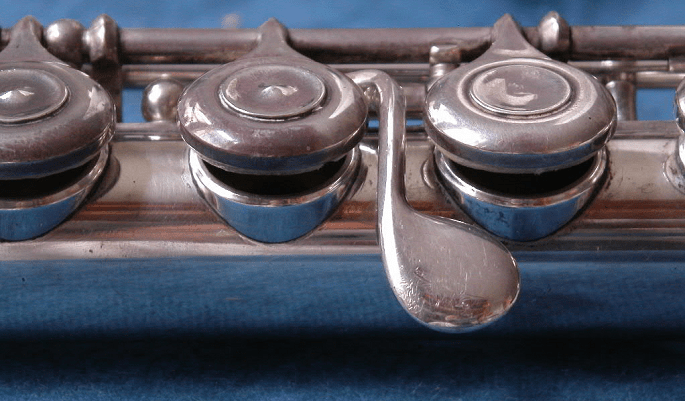

To wrap up this page to mark the day I was made aware of a Haynes flute with “raised nipple” style of key cups – it might be a simple phone call to Haynes that might give me a precise history of this design on this particular instrument. As of now, my theory is that they had experimentally tried to adopt and revive the design of an American-made historical flute. I have never seen a Haynes flute like it before, and you can be sure I will be on a look out for other Haynes with the same design going forward. But I wouldn’t be surprised this was the only instrument that they made with this design – that brief moment, in 1998.
 Open G-Sharp Flute Advocacy