
Thanks for joining me! My excitement on the re-discovery of this almost forgotten mechanism has prompted me to research more and share with the world what I have learned.
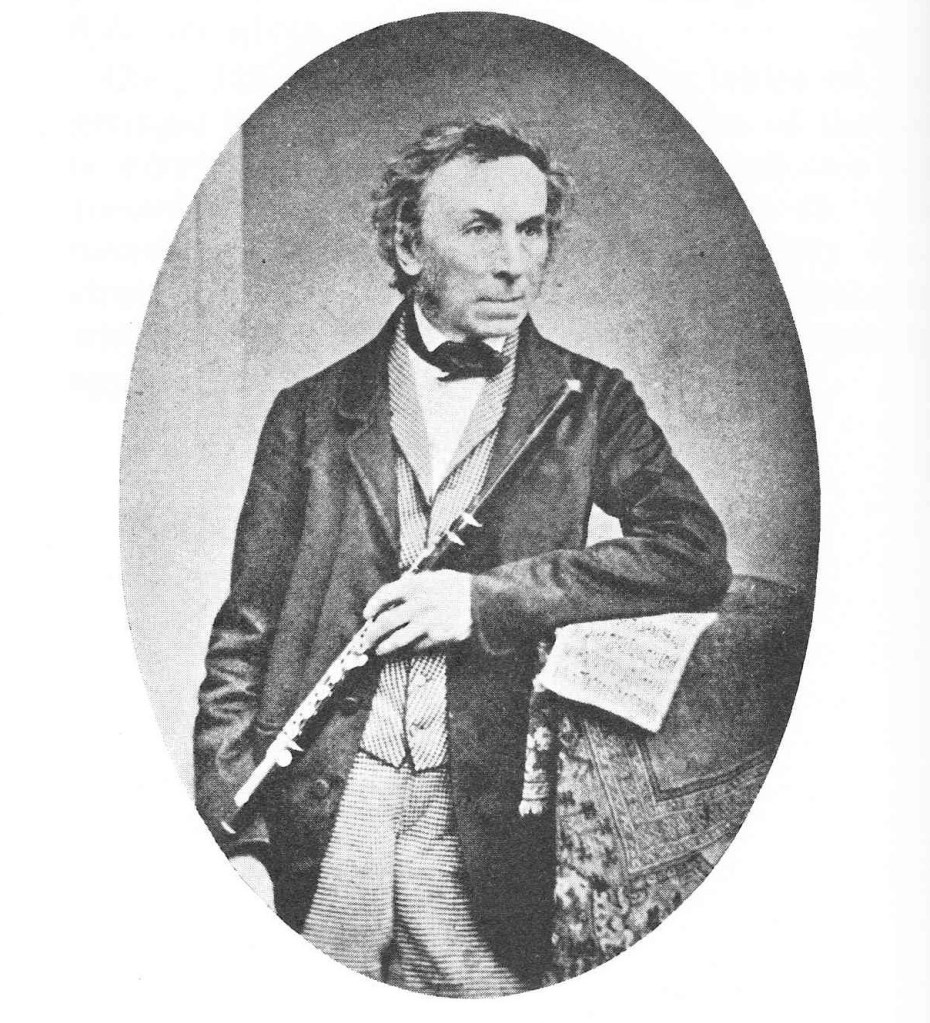
In the planning of my system of fingering, I made the G# key to stand open, like all the rest, only after mature consideration of all the advantages and disadvantages in acoustical, mechanical, and technical respects.
from “THE FLUTE AND FLUTE PLAYING in Acoustical, Technical, and Artistic Aspects” by Theobald Böhm.


Dear Smizumoto,
I agree that the open G-sharp mechanism is the way the flute should be, but why is it called the open G-sharp “KEY”? Even Boehm used this misnomer, but it’s the G-sharp tone hole that is open, and it’s the G-natural key that is sprung open above it. Aren’t keys named for the note produced when they are closed? Maybe the term “single open G-key” mechanism would be better to distinguish it from the traditional flute with duplicate G-sharp tone holes and duplicate G keys (with the one in back sprung closed).
I also wonder if the open G# helps not only the high E, by allowing the proper venting, but the high Eb as well, since there’s no duplicate hole adjacent to the venting hole on top to interfere with the node at that point, like there is on the closed system. (I find that high Eb is prone to cracking to high Ab, similar to high E cracking to high A.)
Finally, although I’m a closed G# player, I have practiced open G# fingerings on my flute and can play an open G# flute fairly well. Like you, I’ve noticed some problems with third octave fingerings, especially when high Eb is involved in fast passages, because of the contrary pinky motion involved (it goes up when the other fingers go down and vice-versa as in D-Eb-F=Eb-D). It’s probably because I’m used to the closed system which makes this easier.
Thank you for starting this website. I look forward to your comments, and I hope there will be more followers and contributors in the near future.
Richard Dalton
June 20, 2020
LikeLike
HI Richard. Thank you for your comment! And I’m glad you have tried and are able to slug your way through Open G# mechanism. And you are so correct in identifying the inconsistency in calling this “Open G#” when in reality it’s the G Key. I came to the same conclusion when I tried to create a chart for padding and had trouble naming the G# key because in reality the key really raises the tone from G to G sharp. Maybe it might be more correct to say “Fourth finger G” as opposed to “Third finger G”.
Here’s one way of looking at the situation – the pre-Boehm system flute has only one hole for G (no key). The third finger down played the G tone. Then the fourth finger (Pinkey) was used to open the G# hole key like today’s instruments. So the tab for the fourth finger without use had “Closed G#”. On the Boehm system flute (with Open G# mechanism), the same action of non-use of the fourth finger had the effect of a G# sound because the tab that normally plays the G# tone is open.
I welcome the day when there is enough interest in this mechanism to make this discussion topic worthwhile to talk about that will change the course of Western Flute history! For now I am happy there is at least one person out there willing to comment. Thank you!
From experience I can say that high E-flat feels correct as well as high E, just like you say. I would say overall everything sounds acoustically better. Of course, if I ever get a chance to “prove” scientifically the difference in acoustics, perhaps this might spark an interest for those flutists who wish to pursue alternative path to expressive playing.
I have much on my thought that I want to post including the above misnomer. I hope to post them one by one. In the mean time, stay safe!
-Shoji Mizumoto
LikeLike