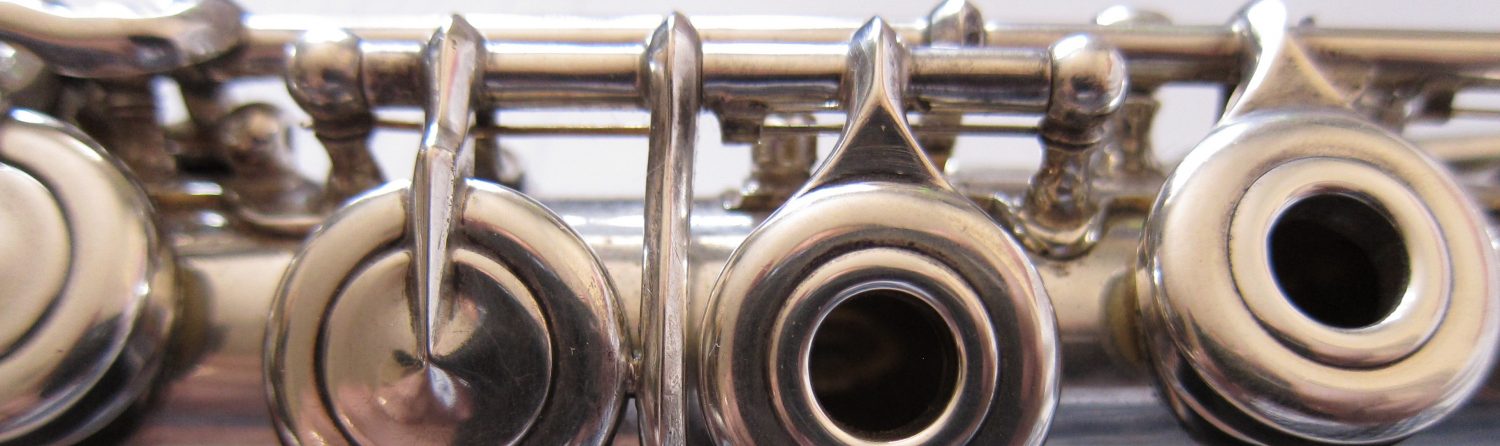
On September 15, 2019, New York Flute Club celebrated 100th Anniversary at the Governor’s Island where 100 flutists gather together to play in a massive flute choir. Carol Wincenc, Robert Dick and the like were all there. When I received the invitation I thought, why not? even though I have not been active in over 5 years. The music that I was assigned appeared to have Alto Flute part, so I took out my Koichiro Sakurai alto flute and “tried” to play. Of course I can no longer play! It’s closed G# key, darn it! It turns out there were enough Alto (alot of alto, haha) and Bass flutists there.
I began to think how nice it would be if my alto could be converted to Open G#.
So, I began looking for Mr. Sakurai’s Website. Found it at http://sakuraiflute.com/ , but it hasn’t been updated since 2013. It turns out Koichiro-san passed away in 2014. It seems his son, Shuhou-san is carrying on the shop. Unfortunately, the website is devoid of contact information! Aaarggghh!
September 26,2019. I finally found a Facebook page and was able to get in touch with Mr. Shuhou Sakurai. I let him know that I have his father’s alto and that because I can no longer play the alto because of the switch and would like, if possible, to convert the alto to Open G# mechanism. That I will be visiting Japan for three weeks in November and perhaps I may be able to meet him and hand him the instrument for the conversion.
September 29, 2019. I received a Messenger reply! He said he would be interested and willing to take this on.
I reply immediately with a question about the slightly higher positioning difference between the rear G# key and whether that might affect the pitch if we only address the front G# key. Would it not force us to remove the rear key totally and seal off the rear key?
September 30, 2019. Mr. Sakurai responds what he plans to do. He would simply remove the finger-key from the rear key-cup assembly which makes the rear key functionally permanently closed, then separate the G# key from the A Key in the front key assembly and make them operate independently, add the finger-key to the Front G# key. This way it would be easier to restore back to Closed G# if so desired. Brazing the rear hole shut would require more work as well as possible damage reheating the tubing might cause. Such work may render years of working the tube metal – back to square one. If there is any issue with scale and pitch, it would be due to the front G# key and it may require resizing it. That would mean replacement of the tone hole which is simply lead-soldered, so it can be done rather simply.
Ok. I was thinking of lead soldering a tube-shaped metal patch where the rear G# key is. But even that I can tell is a hard work. Besides it becomes a permanent change which may not be a good idea if this conversion turns out to be a failure. I would learn from the experience, but I will also reduce the value of the instrument dramatically. So, I relent on this point. It’s still a good experience and it is reversible.
I told Mr. Sakurai that I now agree with him but I would like him to leave the current G#-A key assembly alone and if he might fashion new keys so it will be even easier to reverse back. I also took pictures of the assembly area and e-mailed to Mr. Sakurai.
October 1, 2019. Mr. Sakurai responds thanking me for the pictures and simply said he would have to think about fashioning new keys as that may be difficult.
October 5, 2019. 8:13 am. Several days pass and no further correspondence. Fearing that I may have complicated the project beyond what is reasonable, I wrote to Mr. Sakurai that I am giving up on the idea of keeping the assembly and am willing to go along with the simplest way. I also told him my current schedule in Japan.
That evening 6:44 pm, I received a reply. Mr. Sakurai thought it over with an alto in his shop and came up with a plan. The ring finger G key and cup will be fixed by pin. Then the pinky G# key and its cup will be connected by a bridge. He can accommodate the request for new keys without any issue. The only thing that worried him was that the plating job may take some time to complete. However, he believed it will be ready in time of my departure.
October 12, 2019. A super Typhoon lands near Tokyo area. It was the first time a major storm hit the Kanto area directly. several dozen people drowned in the flash floods that occurred.
October 13, 2019. Worried that Mr. Sakurai’s shop may have been devastated by the storm I tried to send him an email to see if everything is okay. No response.


I own a Gemeinhardt 10AS that was converted to open G# by a gentleman named George Koregelos in Oakland, CA. The bottom G# key was removed, and the key cup was filled with cork, and is “reused” to serve as a plug for bottom G# tone hole.
Mr. Koregelos configured the mechanism in such a way that if third octave E was fingered, it will default to the second/first octave E, and the note will be played as a harmonic. It seems to sound better in tune, and the spatula for the LH little finger need not be depressed.
Mr. Koregelos also reversed the thumb keys.
LikeLike
Thank you ET. I hope all is well with you. I do find the modification you had done on your instrument to be fascinating. Especially the thing about third octave E playing the second/first octave E in harmonics. That kind of means that both G# and A keys somehow get depressed when you finger the high E. I keep trying to imagine how that would be mechanized, and I just can’t picture it, so it is fascinating. I have heard of Mr. Koregelos. I’m sure it was one fine conversion work. Thank you for sharing.
LikeLike
Hi Shoji,
I wish ET would follow up on your Apr. response to his Feb. post. I hope he knows you responded. Anyway, I wonder if Mr. Koregelos converted ET’s flute using something similar to the reversed Dorus mechanism pictured here: https://www.garylewisflutes.com/services/ That’s the only way I know of to deactivate the G# hole in back and repurpose the spatula lever to open the lower G key on top for the notes Ab1-2-3, Eb3, and C4. But there would’ve been be no need to make both G keys close when fingering high E as ET stated – which would be very undesirable concerning tone quality – and why that was done is a complete mystery to both of us. The reversed Dorus that Gary Lewis does is a good alternative and compromise to committing to a full open G# conversion.
Regards,
Rick (Richard Dalton)
LikeLike