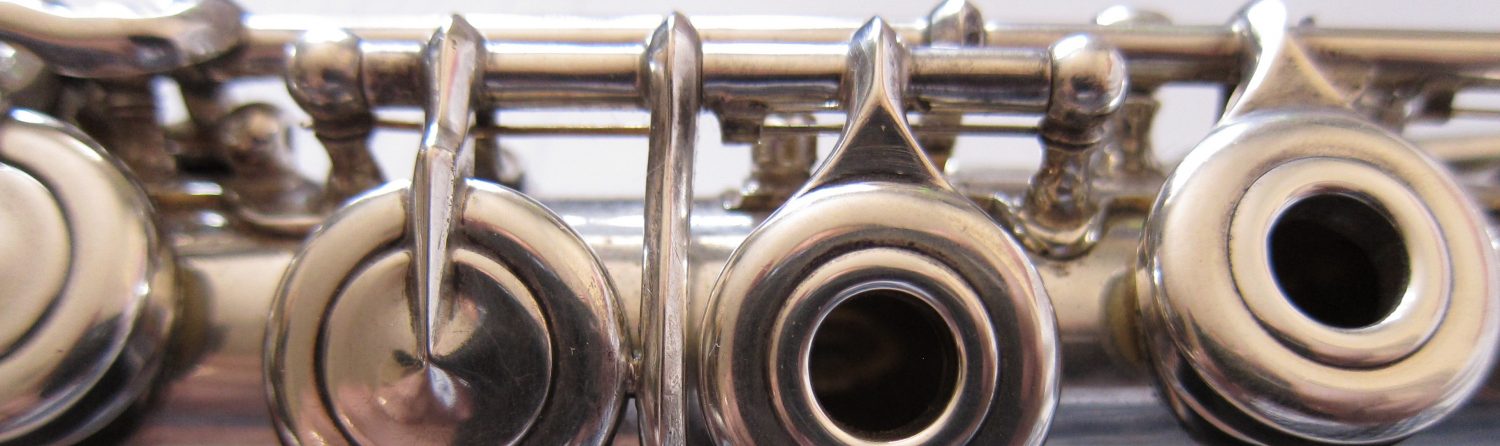

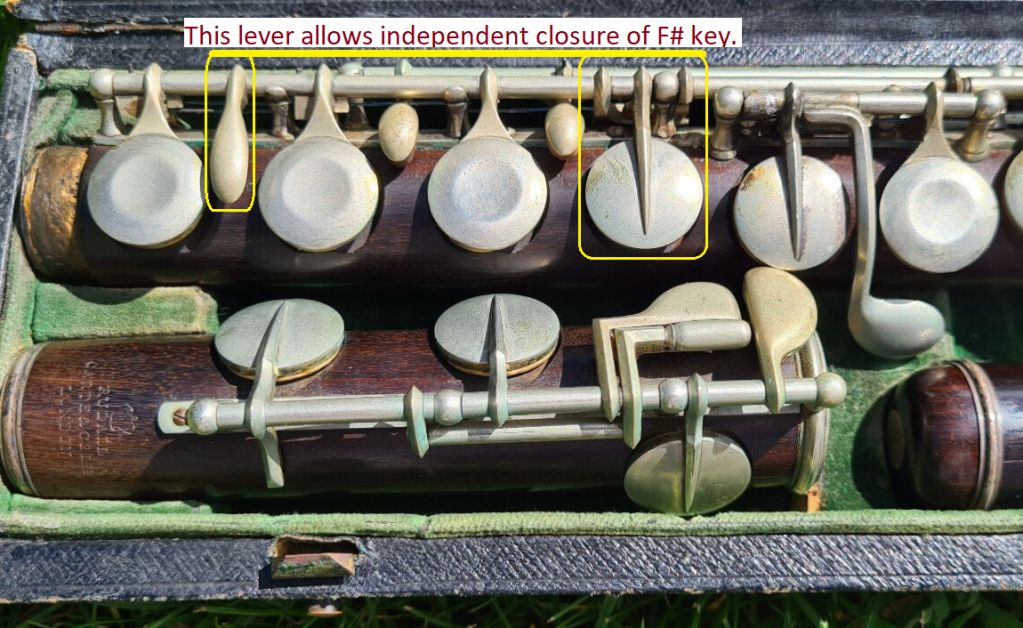
There is an E-Bay Offering right now for a Rudall Carte Wooden Flute that was converted to Open G# mechanism. What is interesting is that it sports what’s called the Rockstro F# Key, which does NOT exist on modern instrument. I hadn’t really understood what that was all about until I saw this instrument and realized how this avoids pressing down on the third finger key of the right hand to obtain F#. Rather the independent appendage (what looks like an oversized trill key) allows closure of the F# key without closing any unnecessary keys. The D-trill and D#-trill keys have simply been moved up one key over!
Why did this matter?
I believe this mechanism is in line with Theobald Böhm ideal that you move up the scale by opening adjacent key only. I’m not sure if anyone’s paid attention to the fact B-flat sounds different 1) when the first finger right hand is used over the F key and 2) B-flat lever operated by first finger right hand or B-flat lever operated by left hand thumb, free of closure of an additional two key s (F# and F keys). This is what Rockstro F# key allows – a very smooth and sonorous transition to the true F# sound, free of closure of the 3rd finger right hand key. Of course, you always need to rely on all available alternate fingerings depending on the note before the said F#, but if sound and continuity of a voice matters more, then this option makes it possible.
After having transitioned to playing with Open G# instrument, I can really appreciate the extent that pioneer flute innovators went in order to achieve a single voice-like scale where all notes are sonorous and of the same quality and timbre.
Notes that offend this single voice-like scale are as follows: F# using 2nd or 3rd finger right hand (without Rockstro mechanism we are forced to use this). Closed G# mechanism goes against this where there is an extra hole/vent for the G# note. And finally, B-flat using first finger right hand goes against this.
With two alternate fingerings for B-flat using left hand thumb or right hand first finger, we can achieve sonorous B-flat. With use of Open G# mechanism we have a sonorous G#. With the Rockstro F# mechanism, now sonorous F# is possible!
 Open G-Sharp Flute Advocacy
Hi Shoji,
The Rockstro F# key is similar to the Brossa F# key. I don’t know which came first, but they are from the late 19th century. There’s also a version of the Brossa with a mechanism for venting the high F# properly. Keefe piccolos has been offering an F# lever for many years, too. I prefer the Brossa because it allows the trill touch keys to stay where they usually are.
Just a reminder, Shoji: I posted late last year letting you know about the Trevor James student model open G# but didn’t see any response. It’s at the bottom of “Response to a comment received on July 12, 2020.” Please tell me what you think.
Regards,
Richard Dalton
LikeLike